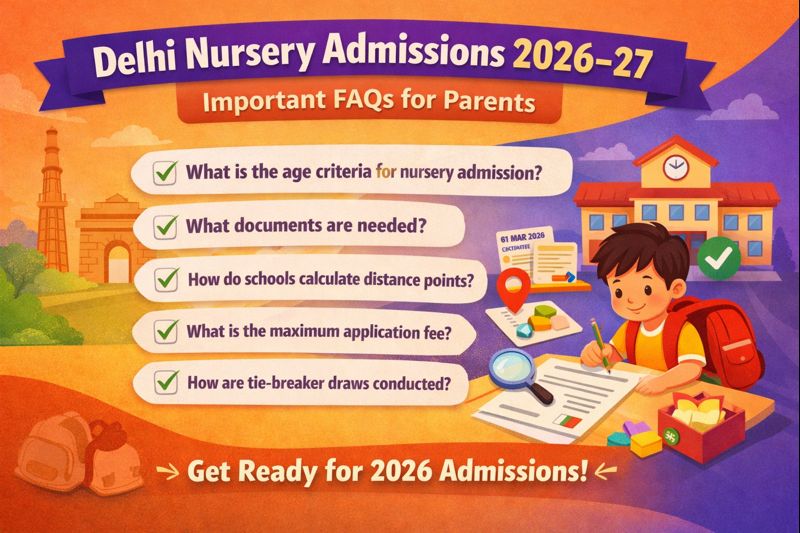


Delhi Nursery Admission Age Criteria 2026–27: What Parents Should Know
Every year, the Delhi Nursery Admission cycle attracts massive attention from parents who are eager to secure a seat for their child in reputed private schools. For the 2026–27 academic session, the Directorate of Education (DoE) has once again emphasized strict adherence to NEP-aligned age norms to create a uniform and transparent admission framework across the city.
If your child is applying for Nursery, KG, or Class 1 in Delhi for the upcoming academic year, understanding the updated age criteria is the most important first step. This guide explains the rules in simple terms and offers insights to help you plan admissions with clarity and confidence.
Why Age Criteria Matter in Delhi School Admissions
The DoE’s age norms ensure that children enter the foundational years at an age that supports their cognitive, emotional, and social growth. The rules are based on the National Education Policy (NEP) 2020, which restructures the schooling system into stages such as foundational, preparatory, middle, and secondary.
For entry-level classes in Delhi, schools must strictly follow the prescribed age brackets, reducing inconsistencies and ensuring that children across the city start school at the right developmental stage.

Official Age Criteria for Delhi Nursery Admission 2026–27
According to the DoE guidelines, the minimum age as on 31 March 2026 should be:
🔹 Nursery (Pre-School): 3 years
Your child must have completed 3 years of age by 31 March 2026.
This means children born between 1 April 2022 and 31 March 2023 are typically eligible.
🔹 KG (Pre-Primary): 4 years
For KG admission, the child must be 4 years or older as on 31 March 2026.
🔹 Class 1: 5 years
For entry into Class 1, the child must have completed 5 years by the same cut-off date.
These norms apply uniformly to all private, unaided, recognized schools in Delhi.
Is There Any Relaxation in the Age Limit?
Yes. Schools may allow up to one month of relaxation in age.
However:
-
This relaxation is not mandatory.
-
The final decision rests with the school’s principal.
-
Parents must often submit a written request if seeking relaxation.
This provision can help parents whose children narrowly miss the cut-off, but approval varies from school to school.
Why the DoE Uses 31 March as the Cut-Off Date
Using 31 March aligns the child’s age with the academic calendar, ensuring that children start school at an age appropriate for the curriculum. This prevents children from entering too early and facing developmental pressure or joining too late and feeling socially out of place.
Common Mistakes Parents Make Regarding Age Criteria
Many parents misunderstand age rules or rely on outdated information. Here are common mistakes to avoid:
❌ Mistake 1: Assuming all schools offer age relaxation
Relaxation is optional and rare in high-demand schools.
❌ Mistake 2: Calculating age incorrectly
Age must be calculated as on 31 March 2026, not the date of form submission.
❌ Mistake 3: Selecting schools without checking age rules first
Always check eligibility before shortlisting schools.
❌ Mistake 4: Rushing for early admission in play schools and expecting automatic progression
Play school or daycare history does not influence eligibility for Nursery in Delhi private schools.
Development Benefits of Following the Age Norms
The age criteria are not only administrative but also developmental. Children aged:
-
3 years are ready for early social interaction, language building, and basic motor skills activities
-
4 years enter the phase of structured learning and curiosity-driven tasks
-
5 years are developmentally prepared for foundational literacy and numeracy tasks introduced in Class 1
These guidelines ensure children are not academically overburdened or socially underprepared.
How Parents Should Prepare Based on Age Criteria
Here’s how you can plan admissions smoothly:
1. Check your child’s birth date carefully
Verify whether your child falls within the eligible window for Nursery, KG, or Class 1.
2. Shortlist schools where your child meets the exact criteria
Do this before filling out forms to avoid rejection.
3. Keep documents ready
Make sure the birth certificate is updated and error-free.
4. If your child narrowly misses the cut-off, plan ahead
You may consider:
-
Requesting age relaxation from the school
-
Opting for another school with more flexible policies
-
Waiting for the next academic cycle if required
5. Monitor DoE updates regularly
Schools must follow DoE rules strictly, so staying updated ensures you meet timelines and new guidelines.
Frequently Asked Questions
1. Can a child younger than 3 years apply for Nursery?
No. Schools must reject applications that do not fulfill the mandatory age requirement.
2. Are age criteria same for all Delhi schools?
Yes, for all private unaided recognized schools under DoE jurisdiction.
3. Does nursery schooling in daycare or play school guarantee eligibility?
No. Only the child’s age as on 31 March 2026 determines eligibility.
4. Will older children be rejected?
Schools prefer children who fall within the defined age range. Over-age applicants may face rejection.
5. Can parents request age relaxation?
Yes, but approval depends entirely on the school.
Final Thoughts
The age criteria for Delhi Nursery Admission 2026–27 form the foundation of the entire admission process. Understanding these rules early helps parents choose the right schools, prepare documents, and navigate applications with confidence.
If your child falls within the correct age window, you can move ahead with shortlisting schools, reviewing their point-based criteria, and preparing for the admission cycle that begins in December 2025.
-
By - UniApply
 5 Min Read