
Delhi Nursery Admissions 2026–27: What Parents Must Check Before Applying
Applying for nursery, KG, or Class 1 admission in Delhi can feel overwhelming—especially with strict rules, tight timelines, and school-specific criteria. For the 2026–27 academic session, parents must be extra cautious while filling application forms, as even small errors can impact admission chances.
This guide breaks down the five most important checks every parent should make before submitting a nursery admission application in Delhi.
1. Confirm Age Eligibility Carefully
Age eligibility is the most fundamental requirement and is calculated as of 31 March 2026. Schools strictly follow these guidelines, and applications that do not meet the age criteria are rejected without exception.
-
Nursery (Pre-School): Child should be 3+ but less than 4 years
-
KG (Pre-Primary): Child should be 4+ but less than 5 years
-
Class 1: Child should be 5+ but less than 6 years
If your child is already studying in a school’s feeder class (for example, Nursery), they usually move to the next class automatically and do not need to reapply.
Parent tip: Always cross-check the date of birth on the birth certificate before filling the form.
2. Understand the School’s Admission Criteria & Point System
Each private school in Delhi follows its own admission criteria and point-based evaluation system, which is published on the school website and the DoE portal.
Common factors considered include:
-
Distance from school (often the highest weightage)
-
Sibling studying in the same school
-
Parent alumni status
-
Staff ward category
-
Availability of seats
Understanding this system helps parents:
-
Shortlist schools realistically
-
Avoid unnecessary applications
-
Focus on schools where chances are stronger
Parent tip: Distance criteria vary from school to school—check how the distance is calculated (road distance vs aerial).
3. Keep All Documents Accurate & Ready
Incomplete or mismatched documents are one of the most common reasons for rejection or reduced points. All details in the application must exactly match the uploaded documents.
Commonly required documents:
-
Birth certificate of the child
-
Valid residential address proof
-
Parents’ identity proof
-
Recent photographs of the child and parents
-
Sibling proof (if applicable)
-
Alumni proof (if applicable)
-
Disability certificate (only for CwD category)
Parent tip: Upload clear, legible documents and avoid last-minute corrections.
4. Know the Application Fee Rules
The Delhi Directorate of Education has capped the nursery admission registration fee at ₹25 per school.
Schools are not allowed to charge:
-
Capitation fees
-
Mandatory donations
-
Additional admission or prospectus fees
Parents should always keep a payment receipt or acknowledgment after submitting the form.
Parent tip: If a school demands extra charges during application, it should be reported.
5. Track Admission Lists & Post-Submission Updates
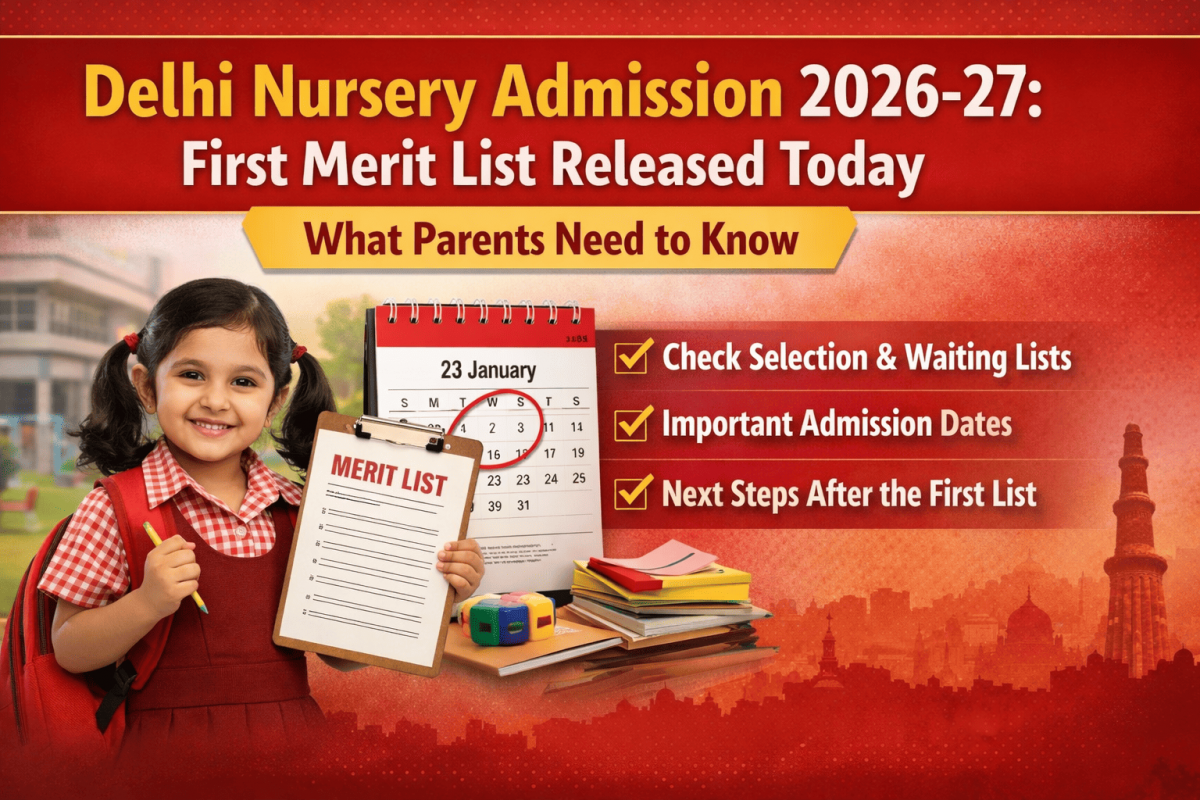
Submitting the application is only the first step. Parents must stay alert and regularly track updates published by schools.
Key stages after submission include:
-
Publication of the list of applicants
-
Display of points awarded
-
Release of first and second admission lists
-
Waiting list movement
-
Grievance redressal window for objections or corrections
In case multiple applicants score the same points for limited seats, schools must conduct a transparent draw of lots, usually in the presence of parents or via recorded proceedings.
Parent tip: Missing a deadline after selection may result in loss of the seat.
Final Checklist for Parents
Before clicking “Submit”, ensure that:
✔ Your child meets the age eligibility
✔ You understand the school’s point system
✔ All documents are accurate and complete
✔ Only the prescribed fee is paid
✔ You are prepared to track admission lists and timelines
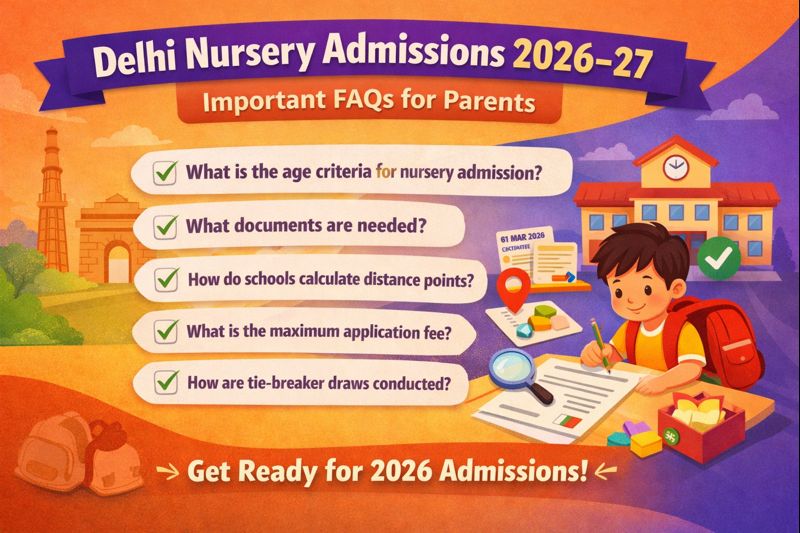
Delhi Nursery Admissions 2026–27: FAQs for Parents
1. What is the age criteria for nursery admission in Delhi for 2026–27?
For the 2026–27 academic session, a child must be at least 3 years old but less than 4 years as on 31 March 2026 to be eligible for Nursery (Pre-School). Schools strictly follow this rule, and applications outside the age bracket are not considered.
2. What is the age requirement for KG and Class 1 admission in Delhi?
-
KG (Pre-Primary): Child must be 4+ but below 5 years as on 31 March 2026
-
Class 1: Child must be 5+ but below 6 years as on 31 March 2026
Age eligibility is mandatory and verified during admission.
3. Do children already studying in a school need to reapply?
No. If a child is already studying in the school’s feeder class (for example, Nursery to KG), they usually get automatic promotion and do not need to apply again unless the school specifies otherwise.
4. How do private schools in Delhi select students for nursery admission?
Private schools follow a point-based admission system. Points are allocated based on criteria such as:
-
Distance between home and school
-
Sibling studying in the same school
-
Parent alumni status
-
Staff ward category
Admission is offered based on total points and seat availability.
5. What documents are required for Delhi nursery admissions?
Commonly required documents include:
-
Birth certificate of the child
-
Proof of residence
-
Parents’ ID proof
-
Passport-size photographs
-
Sibling proof (if applicable)
-
Alumni proof (if applicable)
-
Disability certificate (for CwD category)
All information must match the application form exactly.
6. How is distance calculated for nursery admission points?
Distance is usually calculated from the residential address mentioned in the application to the school campus. Each school may use its own method (road distance or aerial distance), which is clearly mentioned in its admission criteria.
7. What is the maximum application fee for nursery admission in Delhi?
The Directorate of Education has capped the application fee at ₹25 per school. Schools are not allowed to charge any additional fees at the time of registration.
8. Can schools charge donations or capitation fees?
No. Charging donations, capitation fees, or mandatory prospectus charges is strictly prohibited. Parents should report such cases to the concerned authorities.
9. What happens if multiple children score the same points?
If more applicants have the same points than available seats, schools must conduct a draw of lots. The process must be transparent and is usually recorded or conducted in the presence of parents.
10. When are nursery admission lists released in Delhi?
After the application window closes, schools release:
-
List of applicants
-
Points awarded
-
First and subsequent admission lists
-
Waiting list updates
Exact dates are notified by schools and must be followed closely by parents.
11. What is the grievance redressal process for nursery admissions?
Parents can raise objections or request corrections during the grievance window if:
-
Points are calculated incorrectly
-
Documents are wrongly evaluated
-
Admission rules are not followed
Grievances must be submitted within the given timeline.
12. Can parents apply to multiple schools in Delhi?
Yes. Parents are allowed to apply to multiple private schools, provided the child meets the eligibility criteria of each school.
13. Is online application mandatory for nursery admissions?
Most private schools accept online applications, but some may also allow offline submission. Parents should check individual school instructions carefully.
14. What happens if a parent misses the admission confirmation deadline?
If parents fail to confirm admission or complete formalities within the given timeline, the seat may be offered to the next candidate on the waiting list.
15. What is the best way to improve chances of nursery admission in Delhi?
To improve chances:
-
Apply to schools within realistic distance limits
-
Ensure documents are accurate and complete
-
Understand each school’s point system
-
Track admission updates regularly
Final Note for Parents
Delhi nursery admissions are rule-driven and competitive. Staying informed, organized, and proactive throughout the process helps parents avoid last-minute stress and increases the likelihood of securing a seat.
-
By - UniApply
 7 Min Read