
Delhi School Admission Registration Form 2026-27: The Ultimate Parent Guide to Nursery, KG & Class 1 Admissions With DoE Dates, Age Criteria
Delhi’s school admission season is one of the most important phases for parents, especially for Nursery, KG and Class 1 entry. With the Directorate of Education (DoE) releasing revised age criteria under NEP 2020, updated timelines, and strict transparency mandates for private schools, the 2026–27 session brings clarity — but also increased competition.
This detailed guide explains everything you need to know: admission dates, age criteria, documents, point-system, application process on school websites, and how UniApply becomes your most reliable partner for research, shortlisting, comparison, enquiries, and tracking important updates — even though UniApply is not supporting online application submission this year.
Let’s walk through it step by step.
What’s New for 2026–27? Understanding the DoE Rules
The Delhi DoE has implemented consistent and NEP-aligned age rules across all private unaided schools. Schools must follow uniform criteria and cannot set age limits that contradict DoE guidelines.
⭐ Key Changes That Matter to Parents
-
Age norms for Nursery, KG and Class 1 follow NEP 2020.
-
Schools must publish their admission criteria, point-system, and seat details publicly.
-
The registration fee is capped at ₹25.
-
Any kind of capitation fee or forced prospectus sale is prohibited.
-
Schools must follow the official admission calendar strictly.
-
Transparency is mandatory in the draw of lots for open seats.
These measures ensure fairness, transparency, and predictability in the admission process.
Official DoE Admission Schedule for 2026–27
Below is the timeline most private unaided schools in Delhi will follow for Nursery, KG and Class 1 admissions. These are the dates parents must mark in their calendars.
📅 Admission Timeline (2026–27 Session)
| Event | Date / Window |
|---|---|
| Schools upload criteria, point-system, seat matrix | By 28 November 2025 |
| Admission forms released on school websites | 4 December 2025 |
| Last date to submit application form | 27 December 2025 |
| Schools publish list of applicants with points | 9 January 2026 (approx) |
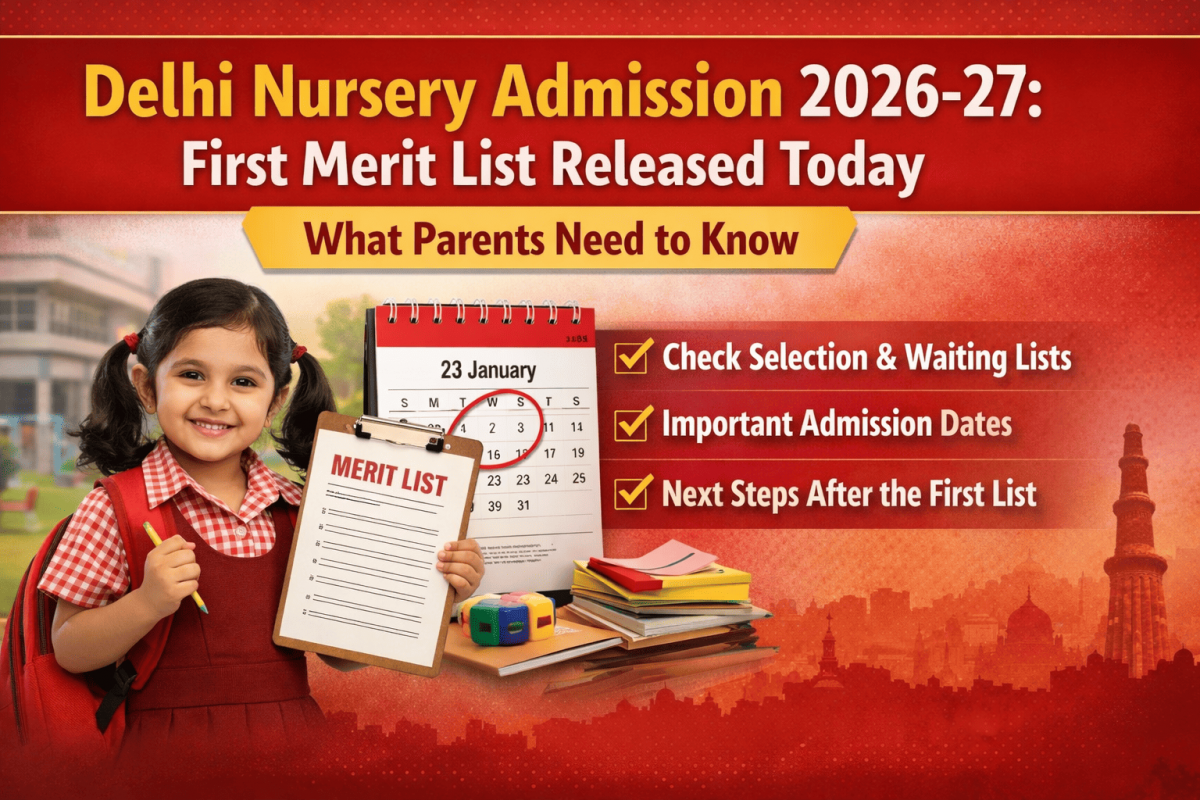
| First selection list | 23 January 2026 |
| Resolution window for grievances | 24 Jan – 3 Feb 2026 |
| Second selection list | 9 February 2026 |
| Admission process closes | 19 March 2026 |
✔ What This Means for Parents
-
Begin shortlisting and preparing documents from October–November 2025.
-
Forms open only for about 3 weeks, so planning is essential.
-
Grievance windows are short — keep an eye on school websites.
NEP 2020 Age Criteria (As on 31 March 2026)
Delhi now follows strict age criteria aligned with national standards. Your child must fit within these age brackets:
| Class | Age Required |
|---|---|
| Pre-Nursery (if offered) | 3+ years |
| Nursery (Pre-School 1 / Balvatika 1) | 4+ years |
| KG / LKG (Pre-School 2 / Balvatika 2) | 5+ years |
| UKG (Pre-School 3 / Balvatika 3) | 5+ years |
| Class 1 | 6+ years |
⭐ One-Month Age Relaxation
Schools may allow a one-month relaxation at the discretion of the principal, but this is not guaranteed.
✔ Tip for Parents
Check your child’s exact age on 31 March 2026. If it’s even a few days off, list schools that clearly mention accepting age relaxation.
Entry-Level Classes Covered in 2026–27
Most private schools admit students at the following levels:
-
Pre-Nursery
-
Nursery
-
KG / LKG
-
UKG
-
Class 1
Class 1 admissions are heavily regulated under RTE norms and follow very strict age eligibility.
Application Process — How Parents Actually Apply
UniApply does not accept application forms right now. Applications must be completed on individual school websites.
Step-by-Step Process for Parents on School Websites
Step 1: Visit the School’s Official Website
Each private school uploads the admission link on their own website.
Step 2: Fill Child & Parent Details
You must provide:
-
Child’s name, DOB, gender
-
Parent names & employment details
-
Address (distance-based points depend on this)
-
Category (General, Sibling, Alumni, etc.)
Step 3: Upload Documents
Keep scanned copies ready:
-
Birth certificate
-
Aadhaar or identity proof
-
Proof of residence
-
Child’s photograph
-
Parent photos
-
Previous school report (if applicable)
-
Certificates for special categories (sibling, alumni, single parent, staff ward etc.)
Step 4: Pay Registration Fee
Schools may charge ₹25 (non-refundable).
Step 5: Print / Save Acknowledgement
This contains your application number, which helps track results.
Step 6: Merit List or Draw of Lots
Schools publish:
-
List of all applicants with points
-
First selection list
-
Second list (if needed)
Parents must visit schools with original documents if selected.
The Point-System: How Delhi Schools Select Students
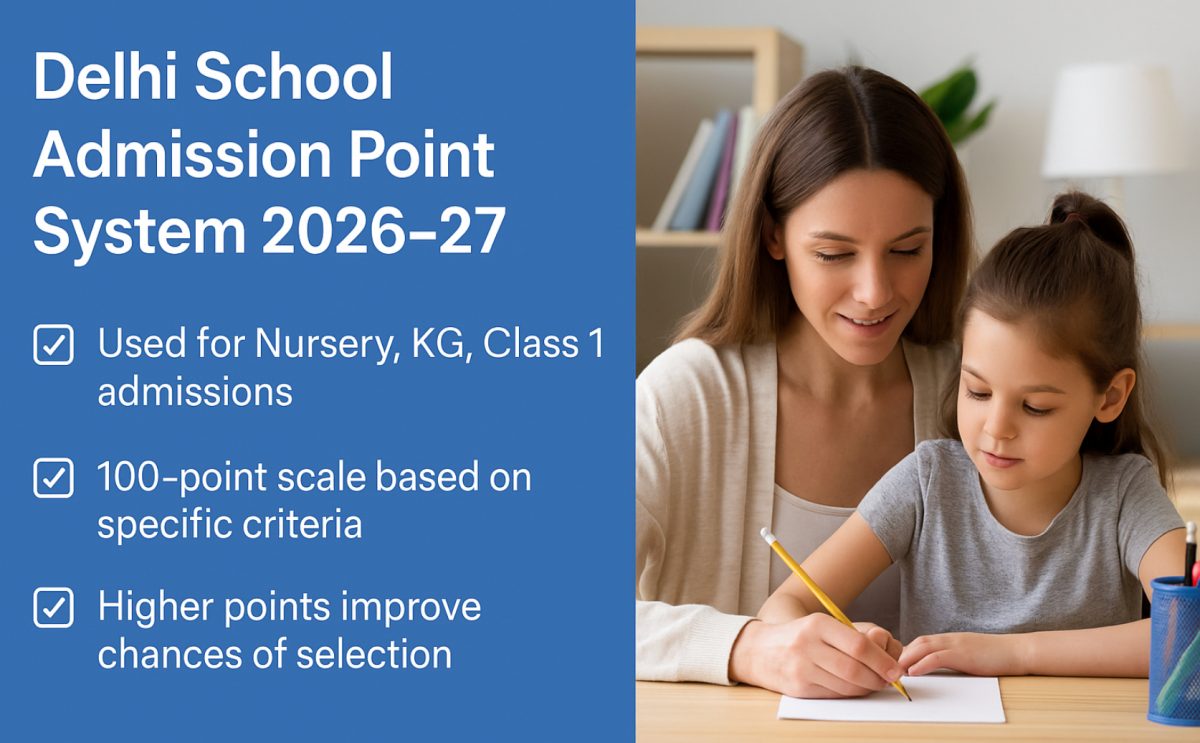
Most schools use a 100-point matrix to ensure fairness. Points are awarded based on:
Common Criteria
-
Distance from school (higher points for closer applicants)
-
Sibling studying in the same school
-
Alumni parent
-
Girl child (school-specific)
-
Single parent / staff ward
-
First born child (school-specific)
Open Seats vs EWS/DG/CWSN
-
75% seats go to General/Open category.
-
25% seats reserved for EWS/DG/CWSN through a government lottery (not conducted by schools).
Draw of Lots
If applicants with equal points exceed available seats, schools conduct a transparent draw of lots. Many record the process or invite parents to attend.
Documents Required for Verification
Once selected, parents must present original documents:
-
Child’s birth certificate (mandatory)
-
Proof of residence (at least 2 kinds are recommended)
-
Parent identity proofs
-
Child and parent photos
-
Vaccination record (sometimes asked)
-
Sibling proof (fee receipt/report card)
-
Alumni proof (school leaving certificate or mark sheet)
Have all documents ready before January 2026 to avoid last-minute rush.
How UniApply Helps You
UniApply serves as a powerful school discovery, comparison, and enquiry platform, especially useful in a complex city like Delhi.
Here’s how UniApply supports your admission preparation:
🔍 1. Discover Schools Easily
-
Search schools by board, fees, distance, ratings, facilities, transport, and more.
-
Learn about labs, sports infrastructure, curriculum, co-curricular focus, teacher-student ratio, etc.
📋 2. View Admission Info Clearly
UniApply displays:
-
Age criteria
-
Important dates
-
Fee structure
-
Required documents
-
Distance criteria
-
Seat availability (if provided by the school)
📊 3. Compare Schools Side-by-Side
You can compare:
-
Fees
-
Facilities
-
Ratings
-
Teaching approach
-
Campus size
-
Transport availability
This makes shortlisting far easier.
📞 4. Enquire Directly with Schools
Using “Enquire Now / School Connect”:
-
Submit interest forms
-
Get school callbacks
-
Ask questions about admissions, fees, or campus visits
-
Stay informed about new openings or last-minute vacancies
📆 5. Track DoE Notifications & School Updates
UniApply monitors official circulars and admission announcements so parents always have the latest information.
🎯 Final Outcome
UniApply prepares you with:
-
Correct information
-
Reliable shortlists
-
Clarity
-
Confidence
so that when applications open, you know exactly where to apply and what to expect.
A Practical Parent Action Plan for 2026–27
📌 October – November 2025
-
Start browsing schools on UniApply.
-
Filter by distance, fees, board and teaching style.
-
Shortlist 8–15 schools.
📌 Before 28 November 2025
-
Check each shortlisted school’s:
-
Admission criteria
-
Point-system
-
Seat matrix
-
📌 4 – 27 December 2025
-
Applications open.
-
Visit each school website and fill forms.
-
Keep your mobile & email active for OTPs.
-
Save application receipts.
📌 9 January 2026
-
Check points awarded by schools.
-
Raise objections if needed.
📌 January – February 2026
-
First and second lists released.
-
Attend verification if selected.
-
Keep backup options ready.
📌 By 19 March 2026
-
Finalize admission.
-
Submit fees and documents on time.
FAQs
FAQs for Delhi School Admission 2026–27
1. Do I need to register on a government portal for private school admissions?
No. Private school admissions in Delhi (Nursery, KG, Class 1) happen directly through school websites, not a central government portal. The DoE only regulates rules, age criteria, and schedules.
2. Can I apply to as many private schools as I want?
Yes. There is no limit. Parents commonly apply to 5–10 schools to increase chances, especially based on proximity and points.
3. What if two schools give the same points?
If applicants tie on points and seats are fewer than applicants, schools conduct a draw of lots. This must be transparent, unbiased, and often recorded.
4. How important is distance for admission?
Distance is one of the highest-weighted criteria in the point-system.
Schools typically award more points to children who live within:
-
0–1 km
-
1–3 km
-
3–6 km
Living closer significantly improves chances.
UniApply’s distance filter helps parents shortlist schools realistically.
5. Can I change the information after submitting the school form?
Generally no. Most schools do not allow editing once the form is submitted.
If there’s a mistake, you must contact the school immediately during the grievance window.
6. Do schools interview children for Nursery admissions?
No. Interviews or formal assessments of toddlers are not allowed under Delhi DoE rules.
Schools may conduct simple parent interaction sessions, but not child interviews.
7. What if both parents are working? Does it impact points?
No. Working parent status does not influence points unless a specific school has a category like:
-
Single parent
-
Girl child
-
First-born child
which are optional criteria.
8. What are EWS, DG, and CWSN categories?
These are reserved categories:
-
EWS – Economically Weaker Section
-
DG – Disadvantaged Group (includes disadvantaged communities & orphans)
-
CWSN – Children With Special Needs
These admissions are conducted through the DoE lottery system, not through private school applications.
9. Can NRIs or foreign citizens apply for Delhi private school admissions?
Yes. Most schools allow NRIs and foreign nationals to apply, but may require:
-
Passport
-
Visa details
-
Proof of residence in India
Always check the school’s specific eligibility guidelines.
10. What is the fee structure approval rule for private schools?
Schools must publish:
-
Annual fees
-
Monthly breakdown
-
One-time charges
-
Refund policy
They cannot increase fees arbitrarily during the academic year.
UniApply lists fee structures clearly for parent comparison.
11. Do schools give preference to first-born children?
Some schools include a first-born child category in their point system, but it is not mandatory.
This varies school to school.
12. Can parents apply if they don’t have all documents ready?
You can fill the form, but final admission requires:
-
Birth certificate
-
Address proof
-
Parent ID
-
Photographs
Missing documents during verification may lead to rejection.
13. What happens if a parent provides incorrect information?
Submitting false information may lead to:
-
Rejection of the application
-
Cancellation of the seat later
-
Blacklisting by the school
Always provide accurate details, especially for sibling/alumni categories.
14. Are transportation facilities considered in admission criteria?
No direct points are given for transport usage.
However, distance from school affects points — which indirectly relates to transport decisions.
15. Do schools refund the admission fee if the child withdraws?
Policies vary.
Most schools:
-
Refund caution money
-
Do not refund admission fees once paid
Always read the school’s refund policy before final payment.
16. How can UniApply help if schools do not answer calls?
Through Enquire Now / School Connect, parents can:
-
Send direct queries
-
Receive call-backs
-
Get timely admission updates
-
Clarify fee and process-related questions
This is faster and more reliable than random calling.
17. Can parents apply to schools outside their zone or district?
Yes, but:
-
Distance points reduce
-
Chances of selection may be lower
Use UniApply’s distance filter to shortlist realistically.
18. If my child is not selected in the first list, should I wait?
Yes. Many schools release:
-
Second lists
-
Waiting lists
-
Spot admissions (if seats remain)
Parents should track multiple schools simultaneously.
19. Is donation-based admission allowed?
Absolutely not.
Capitation fees or donations are illegal in Delhi school admissions.
20. How early should parents start preparing?
Ideally 2–3 months before the admission window:
-
Shortlist schools
-
Check eligibility
-
Prepare documents
-
Track admission dates
UniApply simplifies this entire preparation journey.
Final Guidance for Parents
The Delhi school admission 2026–27 cycle is structured, transparent, and time-bound. With NEP age norms fully implemented and DoE enforcing strict publication of criteria and dates, parents now have a clearer path — but preparation is everything.
UniApply plays a crucial supporting role by helping you:
-
Understand admission rules
-
Compare schools wisely
-
Shortlist schools confidently
-
Track updates
-
Communicate with school teams
When application forms go live, the families who are well-prepared, organized, and informed will find the process smoother and less stressful.
We hope this detailed guide empowers you to plan well and give your child the best possible start to their academic journey.
-
By - UniApply
 10 Min Read