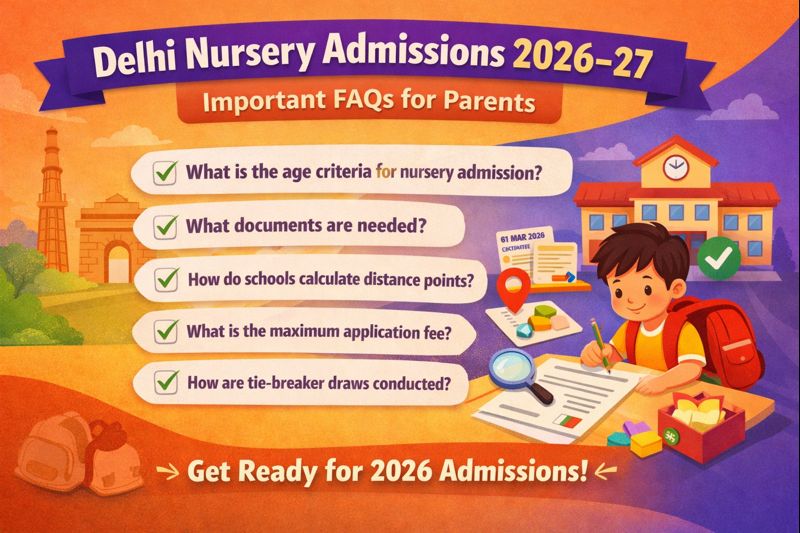


New Pre-Primary Age Rules in Delhi Schools from 2026–27: What Parents Need to Know
The Delhi Directorate of Education (DoE) has officially announced new age criteria for pre-primary classes (Bal Vatika) in all government, private, and aided schools, starting from the 2026–27 academic session.
This update is part of the National Education Policy (NEP) 2020 implementation, which introduces a structured Foundational Stage with three years of pre-primary learning before Class 1.
What Are the New Pre-Primary Age Criteria in Delhi?
Under the NEP-aligned structure, pre-primary education will be divided into three stages called Bal Vatika 1, 2, and 3:
| Class | Age Range | Academic Stage |
|---|---|---|
| Nursery (Bal Vatika 1) | 3–4 years | First pre-primary level |
| Lower KG (Bal Vatika 2) | 4–5 years | Second pre-primary level |
| Upper KG (Bal Vatika 3) | 5–6 years | Third pre-primary level |
| Class 1 | 6–7 years | Primary level begins |
This new age structure ensures that children are developmentally ready when they enter Class 1.
No Impact on Current Students
Parents can relax — no child currently enrolled will have to repeat a class.
DoE Director Vedita Reddy clarified that:
-
Children in Nursery (Bal Vatika 1) in 2025–26 will naturally move to KG (Bal Vatika 2) in 2026–27.
-
Children already in KG will progress to Class 1 as usual.
-
No student will be held back or forced to repeat a year.
Even for students transferring between schools, the new age rule will not cause any issues — valid School Leaving Certificates (SLC) and report cards will be honored.
Phased Implementation Plan
To ensure a smooth transition, the DoE will implement these changes gradually:
-
2026–27: Only Nursery (Bal Vatika 1) admissions begin (3–4 years).
-
2027–28: Lower KG (Bal Vatika 2) and Upper KG (Bal Vatika 3) introduced.
-
2028–29: The 6+ years rule for Class 1 becomes fully applicable.
Schools have been advised to update parents, reorganize class structures, and prepare promotion lists accordingly.
Age Relaxation for Admissions
A one-month age relaxation will be allowed at the school’s discretion.
For instance:
Children aged 2 years 11 months or 4 years 1 month at the time of Nursery admission may still be considered eligible.
This ensures flexibility for parents and avoids unnecessary admission rejections.
Why This Change Matters
This age alignment supports:
-
Better cognitive and emotional development before entering primary classes.
-
Stronger foundational learning, as outlined in NEP 2020.
-
A uniform structure across all Delhi schools — government and private alike.
For parents, it means clearer admission criteria, reduced confusion, and improved learning outcomes for their children.
Summary for Parents
| Key Point | Details |
|---|---|
| Policy Effective From | 2026–27 academic year |
| Impacted Classes | Nursery to Class 1 |
| Ages for Admission | Nursery: 3–4 years, Class 1: 6–7 years |
| Affect on Existing Students | No repeat year or transfer issues |
| Flexibility | 1-month relaxation allowed |
| Goal | Alignment with NEP 2020 Foundational Stage |
FAQs: Delhi Pre-Primary Age Rules (2026–27)
Q1. Will my child have to repeat Nursery or KG due to the new rule?
No. The Directorate has confirmed that no currently enrolled student will be affected by this policy. Promotions will continue as usual.
Q2. What if my child turns 3 after the admission cutoff date?
Schools have the flexibility to allow up to one month of age relaxation, so your child may still be eligible for admission.
Q3. Does this rule apply to private schools as well?
Yes. The rule applies to all government, private, and aided schools in Delhi.
Q4. Why has the DoE made this change?
To align Delhi’s school admission structure with the NEP 2020, which recommends three years of foundational learning before Class 1.
Q5. From which session will Class 1 follow the 6+ age rule?
The 6+ years rule for Class 1 will be fully enforced from 2028–29.
Explore Schools Following NEP-Aligned Admission Criteria
Check verified schools in Delhi that follow NEP-based early education programs on UniApply.
Compare age eligibility, fees, and admission dates in one place.
-
By - UniApply
 4 Min Read