

Delhi School Admission 2027-28: Complete Admission Guide, Dates, Age Criteria, Documents & Schools
Delhi School Admission 2027-28
Finding the right school for your child is one of the biggest decisions you’ll make as a parent. Every year, thousands of families in Delhi search for the best schools while trying to understand admission timelines, eligibility rules, school fees, point systems, and required documents.
The admission process can seem complicated because every school has its own admission policy while following the guidelines issued by the Directorate of Education (DoE), Government of NCT of Delhi.
This guide has been created to simplify the entire admission journey. Whether you’re applying for Nursery, KG, Class 1, or higher classes, you’ll find everything you need in one place—from choosing the right school to completing the admission successfully.
Important: The official Delhi School Admission 2027-28 notification has not been released yet. The information in this guide is based on the latest admission framework and previous admission cycles. We will update this guide once the official schedule is announced.
Delhi School Admission 2027-28 Overview
Delhi has one of India’s most organized school admission systems. Every academic year, admissions open for different school categories, including private schools, government schools, aided schools, and international schools.
Parents can apply for:
- Nursery
- Balvatika
- Kindergarten (KG)
- Class 1
- Class 2 onwards (subject to seat availability)
- Mid-session admissions (limited schools)
Most schools begin accepting applications a few months before the new academic session starts in April.
Unlike many cities, Delhi schools often follow a transparent admission process where schools publish their admission criteria, eligibility conditions, and selection methodology in advance.
Expected Delhi School Admission Timeline 2027-28
Although the official dates are yet to be announced, parents can generally expect the admission process to follow this pattern.
|
Admission Stage |
Expected Timeline |
|
Admission Guidelines Released |
November 2026 |
|
Schools Publish Admission Criteria |
November 2026 |
|
Application Forms Available |
November–December 2026 |
|
Last Date to Apply |
December 2026 |
|
First Merit List |
January 2027 |
|
Second Merit List |
January–February 2027 |
|
Document Verification |
January–February 2027 |
|
Fee Submission |
February–March 2027 |
|
New Academic Session |
April 2027 |
Types of Schools in Delhi
Delhi offers a wide variety of schools catering to different educational philosophies, budgets, and learning needs.
Private Schools
These schools conduct admissions independently while following DoE guidelines. Parents need to apply separately to each school.
Ideal for:
- Modern infrastructure
- Sports facilities
- International exposure
- Multiple extracurricular activities
Government Schools
Government schools provide affordable education with quality improvements under the Delhi education model.
Suitable for families looking for:
- Affordable education
- Strong academic foundation
- Government-supported facilities
Government-Aided Schools
These schools receive government support but are privately managed.
CBSE Schools
The majority of schools in Delhi follow the CBSE curriculum, making them a preferred choice for families planning competitive exams later.
ICSE Schools
Known for a broader curriculum with strong emphasis on English language and analytical learning.
IB & Cambridge Schools
International schools offer globally recognized curricula suitable for families planning overseas education.
Which Class Can You Apply For?
Parents commonly apply for:
|
Child Age |
Admission Level |
|
Around 3 Years |
Nursery / Balvatika 1 |
|
Around 4 Years |
Balvatika 2 |
|
Around 5 Years |
Balvatika 3 |
|
Around 6 Years |
Class 1 |
Admissions to higher classes depend on available seats and school-specific policies.
Age Criteria for Delhi School Admission 2027-28
Age eligibility is one of the most important factors during school admissions.
Parents should ensure that their child’s age matches the prescribed age requirements for the class they are applying to. Schools generally do not accept applications that fall outside the permitted age range unless relaxation is allowed under specific circumstances.
Before applying:
- Verify your child’s date of birth.
- Check the school’s official age criteria.
- Keep the birth certificate ready.
- Confirm the age cut-off date announced for the academic session.
Eligibility Criteria
Most schools consider the following eligibility conditions:
- Child falls within the prescribed age limit.
- Parent provides valid residential proof.
- Required documents are available.
- Application is submitted before the deadline.
- School-specific admission requirements are fulfilled.
Documents Required for Delhi School Admission
Keeping all documents ready before admissions begin can save valuable time.
Child Documents
- Birth Certificate
- Passport-size photographs
- Aadhaar Card (if available)
- Vaccination record (if requested)
Parent Documents
- Aadhaar Card
- PAN Card (where applicable)
- Passport-size photographs
Address Proof
Any one of the following may be accepted:
- Aadhaar Card
- Passport
- Voter ID
- Electricity Bill
- Water Bill
- Registered Rent Agreement
- Property Tax Receipt
Additional Documents
Depending on the school, you may also need:
- Sibling proof
- Alumni certificate
- Transfer Certificate
- Previous report card
- Medical certificate
- Caste certificate (where applicable)
- Income certificate (for applicable categories)
How to Choose the Right School
Many parents shortlist schools based only on rankings. However, the best school is the one that aligns with your child’s needs, family priorities, and long-term goals.
Consider these factors before applying:
Academic Performance
Review board exam results, teaching quality, and academic support.
Distance from Home
A shorter commute reduces travel fatigue and allows children more time for studies and extracurricular activities.
School Board
Choose between:
- CBSE
- ICSE
- IB
- Cambridge
- State Board
based on your child’s future educational plans.
Safety
Look for:
- CCTV surveillance
- Verified transport staff
- Medical room
- Security personnel
- Safe campus
Teacher Quality
A good student-teacher ratio and experienced faculty contribute significantly to a child’s learning.
Infrastructure
Evaluate:
- Classrooms
- Science labs
- Computer labs
- Libraries
- Sports facilities
- Art and music rooms
Parent Reviews
Read authentic parent experiences to understand the school’s communication, culture, and overall environment.
Step-by-Step Delhi School Admission Process
Step 1: Research Schools
Create a shortlist based on:
- Budget
- Distance
- Board
- Facilities
- Academic performance
Step 2: Compare Admission Criteria
Every school publishes its own eligibility conditions and selection criteria.
Step 3: Collect Documents
Prepare both digital and physical copies.
Step 4: Fill Application Forms Carefully
Double-check every detail before submission.
Common mistakes include:
- Incorrect date of birth
- Wrong address
- Missing documents
- Incorrect phone number
Step 5: Submit Before Deadline
Avoid waiting until the last day.
Step 6: Monitor Merit Lists
Schools usually publish multiple admission lists.
Step 7: Complete Verification
Carry original documents for verification.
Step 8: Pay Admission Fees
Complete the admission formalities within the stipulated timeline.
Delhi Nursery Admission Point System Explained
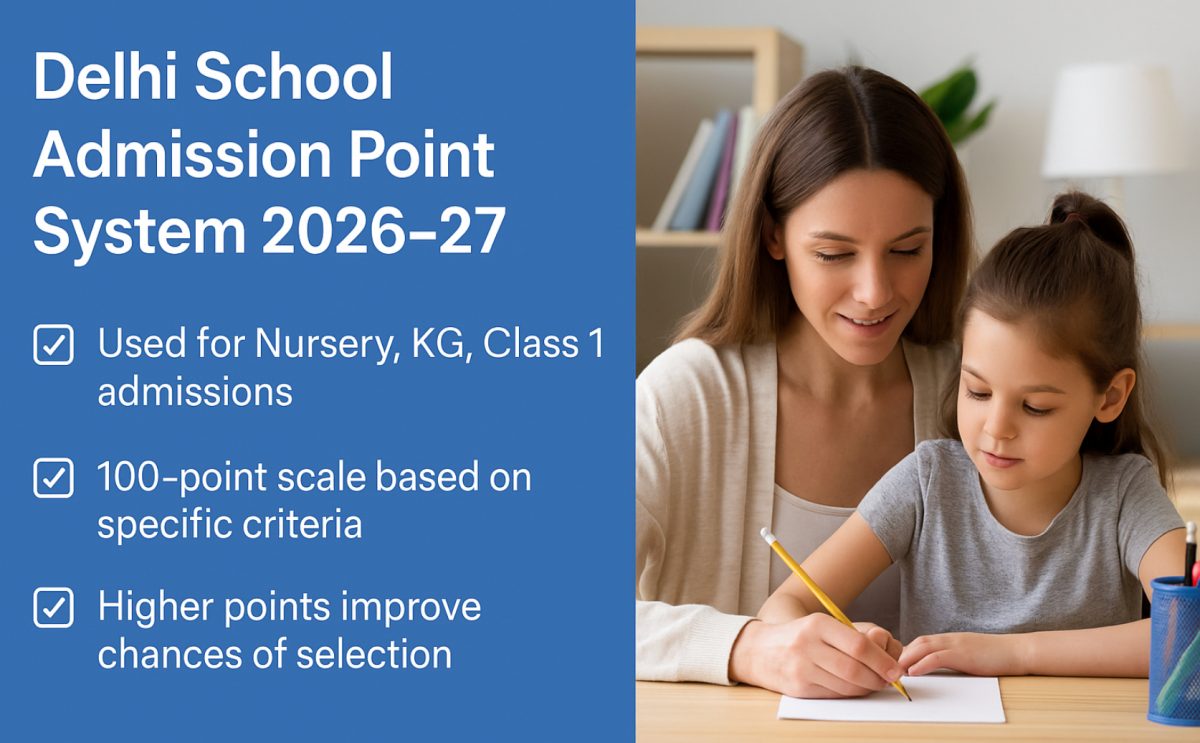
Many private schools use a transparent point-based admission system.
Common evaluation parameters include:
|
Criteria |
Purpose |
|
Distance from School |
Encourages neighbourhood admissions |
|
Sibling Studying |
Keeps siblings together |
|
Alumni Parent |
Rewards former students |
|
Girl Child |
Promotes gender diversity |
|
Single Parent |
Supports diverse family structures |
|
First Born |
Offered by some schools |
Each school determines its own point allocation and publishes it before admissions begin.
Understanding Neighbourhood (Distance) Criteria
Schools often prioritize children living close to the campus.
Typical distance slabs may include:
- 0–3 km
- 3–6 km
- Beyond 6 km
Parents should verify the distance calculation method used by each school before applying.
Sibling Preference
If an elder sibling is already enrolled in the school, additional preference may be given.
Schools usually require proof such as:
- Student ID
- Fee receipt
- Bonafide certificate
Alumni Preference
Several schools offer additional consideration if one or both parents are alumni.
Keep alumni details and supporting documents ready if applicable.
EWS and Reserved Category Admissions
Certain schools reserve seats under the Economically Weaker Section (EWS), Disadvantaged Group (DG), and other applicable categories as per government regulations.
Eligible families should:
- Check eligibility requirements.
- Keep income and category certificates ready.
- Apply within the specified timeline.
- Track lottery or allotment announcements.
Admission to Government Schools
Government school admissions generally involve:
- Online registration (where applicable)
- Document verification
- Age verification
- School allotment based on applicable rules
Admission to Private Schools
Private schools generally follow this process:
- Publish admission criteria
- Accept applications
- Review applications
- Release admission lists
- Verify documents
- Collect admission fees
- Confirm enrollment
Admission to Higher Classes
Admissions beyond the entry level depend on:
- Vacant seats
- Transfer Certificate
- Previous academic performance
- School-specific assessment (where applicable)
Understanding School Fees
Parents should understand the complete fee structure before accepting an admission offer.
A school’s total cost may include:
- Registration Fee
- Admission Fee
- Tuition Fee
- Annual Charges
- Development Fee
- Activity Fee
- Smart Class Fee
- Laboratory Fee
- Transport Charges
- Books and Uniforms
Always request a detailed fee breakup and review the school’s refund policy, payment schedule, and any optional charges.
15 Smart Tips for Parents Before Applying
- Start researching schools at least six months before admissions.
- Visit shortlisted schools if possible.
- Apply to multiple schools rather than relying on one option.
- Verify the latest admission criteria directly from the school.
- Keep scanned copies of all documents ready.
- Use the same spelling of your child’s name across all documents.
- Track important deadlines using a calendar.
- Save application receipts and confirmation emails.
- Monitor school websites regularly for updates.
- Prepare a realistic school budget, including transport and annual expenses.
- Consider travel time during peak traffic.
- Speak with current parents to understand the school’s environment.
- Compare facilities and learning support, not just rankings.
- Keep backup school options ready.
- Read the admission policy carefully before paying fees.
Common Mistakes Parents Should Avoid
- Applying after the deadline
- Ignoring age eligibility
- Submitting incomplete documents
- Applying to too few schools
- Not checking neighbourhood criteria
- Missing merit list announcements
- Delaying fee payment after selection
- Assuming all schools follow identical admission rules
Delhi School Admission Checklist
Before submitting your application, ensure you have:
- ✔ Shortlisted schools
- ✔ Verified age eligibility
- ✔ Collected required documents
- ✔ Checked admission criteria
- ✔ Compared fee structures
- ✔ Reviewed transport availability
- ✔ Submitted applications on time
- ✔ Saved application receipts
- ✔ Noted important admission dates
- ✔ Prepared original documents for verification
How UniApply Helps in Delhi School Admission 2027-28
UniApply simplifies the school admission journey by helping parents discover, compare, and connect with schools across Delhi—all in one place.
Here’s how UniApply helps:
-
Find the Right School: Search schools by location, board (CBSE, ICSE, IB, Cambridge), fees, and facilities.
-
Compare Schools: Compare multiple schools side-by-side based on fees, curriculum, infrastructure, and amenities.
-
Access Detailed School Information: Explore admission details, fee structure, facilities, contact information, and school profiles.
-
Connect with Schools: Submit enquiries directly to schools to learn about admissions, eligibility, and seat availability.
-
Explore by Locality: Find schools in areas like Dwarka, Rohini, Vasant Kunj, South Delhi, East Delhi, and more.
-
Save Time: Research, compare, and shortlist schools from a single platform instead of visiting multiple websites.
Why Choose UniApply?
-
Comprehensive school database
-
Easy school comparison
-
Verified school information
-
Location-based search
-
Direct enquiry with schools
-
Parent-friendly and time-saving platform
Note: UniApply is a school discovery and enquiry platform that helps parents make informed decisions. Admissions are conducted by individual schools as per their admission policies and seat availability.
Frequently Asked Questions
When will Delhi School Admission 2027-28 begin?
Admissions are expected to begin in the last quarter of 2026. The official schedule will be announced before applications open.
Can I apply to more than one school?
Yes. Parents are encouraged to apply to multiple schools to improve admission opportunities.
Is there an entrance test for Nursery admission?
Most entry-level admissions are based on published admission criteria rather than academic testing.
Can I apply for Class 2 or higher?
Yes, subject to seat availability and the individual school’s admission policy.
How many schools should I apply to?
Applying to 5–10 schools that match your child’s eligibility, budget, and location is generally a practical approach.
What happens if my child is placed on the waiting list?
If seats become available due to withdrawals or additional vacancies, schools may offer admission to waitlisted candidates based on their admission policy.
Final Thoughts
Delhi School Admission 2027-28 is about much more than meeting deadlines—it is about choosing an environment where your child can learn, grow, and thrive. Starting your research early, understanding each school’s admission policy, keeping documents organized, and applying strategically can significantly improve your chances of securing admission.
Rather than focusing solely on rankings, evaluate schools based on academics, safety, teaching quality, values, extracurricular opportunities, commute, and affordability. A thoughtful, well-planned approach will help you make an informed decision that supports your child’s long-term educational journey.
-
By - UniApply
 10 Min Read